Life as a Student Sports Broadcaster
- Aiden Glendenning

- Apr 28
- 6 min read
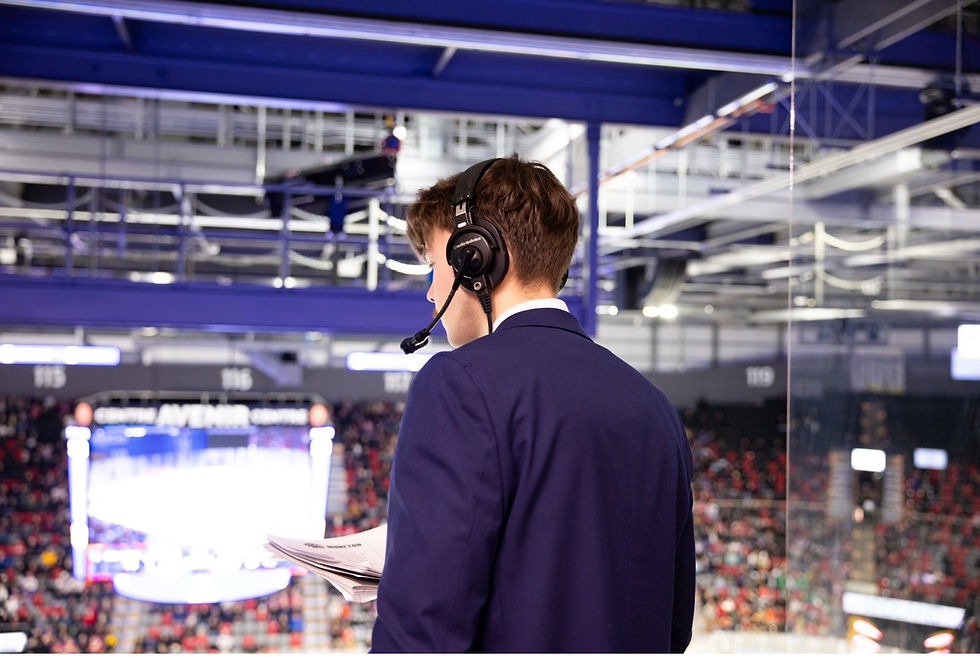
At the Avenir Centre in Moncton, N.B., the noise doesn’t hit you all at once. It builds. It swells. It turns into a constant pressure in your chest as fans settle into the building.
Before puck drop, there’s warmup chaos. Sticks rattle along the boards. Pucks crack off the glass. Skates carve tight circles while fans lean forward as if they’re trying to pull the game closer. Out in the concourse, voices bounce off the concrete, then fade into a low, steady hum that feels like anticipation.
I’m way up above section 105, squeezed into a broadcast booth that’s basically a narrow box in the rafters. No chairs. Just a thin ledge where papers are both stacked and scattered. Stat sheets, scribbles, and names circled so hard they dented the page. Arrows pointing to reminders I didn’t trust myself to remember. Behind us, a replay monitor flickers. Water bottles sit within reach, because three hours of talking has its own kind of endurance.
The first time I stood there with a headset on, I kept sneaking one last look at my notes, like I could cram calmness into my brain at the final second. Marty Kingston—a longtime Moncton Wildcats broadcaster and city councillor—stood beside me. He looked like he belonged there. For him, it was just another game night. He had been doing this for over 30 years. For me, it felt like stepping into a play when I hadn’t learned my lines.
The headset popped. Three. Two. One. We were live.
Being the play-by-play guy, Marty opened the broadcast. Introducing the matchup steadily and smoothly. Then he tossed it over to me. My role was colour—break things down, add context, fill in the details between plays and help entertain the audience during stoppages in play. I remember my first few words coming out tighter than I expected, like I was trying not to trip over them. I, of course, made my fair share of mistakes throughout the night—most notably mispronouncing the opposing team's name, but in my defence, it was extremely French, and that isn’t my forte. After a while, I remember I said something simple about the pace in warmups, how both teams looked sharp. Nothing special. But it got me settled in. That was the moment I realized this wasn’t just about talking hockey. It was about trusting myself to speak, to react, to be part of something happening in real time.
Wanting to be a hockey broadcaster grew from the same place my love for hockey did. As a kid, winter after winter, my life was measured in rink time instead of real time—early practices where your fingers go numb tying your skates, late games where you’re half asleep in the back seat afterwards. Road trips with teammates, the smell of sweat and stale equipment, hours on the ice until the lines felt like home. Like a lot of kids in Canada, I carried the dream without thinking about it—make the NHL. You picture the lights, the crowd, your name being announced. But time has a way of sanding that dream down. The older you get, the clearer the gap becomes. You understand the odds and you stop pretending you’re the exception.
However, the love doesn’t leave. It just finds somewhere else to go.
I liked being on camera when I was younger. Making people laugh. Holding attention. At one point, I thought about starting a YouTube channel, putting something out into the world and seeing who showed up. Eventually, it clicked. If hockey was what I cared about most, and being on camera felt natural, broadcasting sat right in the middle. It was a different way of staying close to the game.
People talk about public speaking as the challenge. Calling hockey live adds another layer. Then another. There’s no pause button. No editing. No second take. Once the mic is live, whatever you say is already out there. And now, anything can be clipped and shared within seconds. Hockey doesn’t wait either. The puck moves too fast. One second it’s in your zone, the next it’s gone, and your thoughts have to chase it.
Early on, the hardest part wasn’t understanding the game. It was learning how to speak while my brain sprinted. I’d start breaking down a play and realize I was already behind, teams lining up for a faceoff while I was still finishing my thought.
Sometimes my mind would just go blank mid-sentence. Names I had said minutes earlier disappeared when I needed them most. Even now, I’ll glance at my notes during an icing, look back up—and the puck has already dropped.
My first broadcast had its own kind of embarrassment. I mispronounced “Saguenéens” for nearly the entire game, saying it differently every time I tried to correct it. Unfortunately, that’s live broadcasting. Nobody gets it perfect. The skill isn’t perfection—it’s recovery. You correct yourself, keep going, and don’t let the mistake become the story.
A big thing I’ve learned from Marty is that preparation is everything.
On game days, I get to the arena about two hours early. That gives me time to settle in, scan storylines, and turn a pile of information into something usable. The stat pack looks like code—pages of numbers, scoring leaders, goalie stats, trends. Useful, but numbers don’t tell a story on their own.
So, I add my own layer. Mark streaks. Flag milestones. Note things people might miss and want to hear about. Sometimes it’s small—a goalie playing his 13th back-to-back, showing how much trust his coaches have in him to perform in those scenarios. It takes seconds to say on air, but it adds depth.
Marty drilled the basics into me early: show up prepared and enjoy it. Anyone can read stats. The job is turning them into something people actually want to follow. Still, live broadcasting always throws something at you.
One of my first intermission interviews proved that. I thought it would happen somewhere quiet. Instead, they put us right on the bench, in full view of the arena. The player in question was the 4th overall NHL draft pick, Caleb Desnoyers. He came over still in full gear, helmet on, hair soaked, a towel draped over his shoulders. He sat down immediately, elbows on his knees, catching his breath, water bottle in hand.
Out of frame, my supervisor started signaling for him to stand up. Production clearly had a different vision. The player didn’t move. We were already live. For a few seconds, it turned into this silent standoff—frantic gestures out of view, complete calm on camera. So, I made a call. I sat down beside him and kept going like that was the plan all along.
I asked him about his last shift, about the pace of the game and how the team was handling the forecheck. Short answers, still catching his breath. The interview worked. Two of us sitting there, just talking hockey. That’s how this job goes. Plans shift, and just like life, you have to adjust.
Confidence didn’t come all at once. It is built in small moments. A clean pregame segment. A message from a fan. Someone saying they heard you and liked it. One night stands out—my first overtime winner.
The puck was picked up near centre ice. It was a quick transition the other way. You could feel the building rise before anything even happened. The rush came fast. Wildcats #86 Niko Tournas skated into the offensive zone and took a quick shot, straight past the goaltender with speed, and they won.
I remember my voice jumping without thinking, trying to keep up with the moment as the crowd exploded underneath us. Later, the QMJHL even shared the clip on social media. I remember a family member of mine saying I sounded like someone on a national broadcast. For my second game, that felt unreal to hear something like that. Moments like that add up too. Every time I get a compliment on my work it reminds me that people are listening.
All of this is working toward becoming a broadcaster while I’m finishing school. Fourth year, double major in journalism and digital media, minor in communications. Balancing all of my classes with the broadcasting gig isn’t easy. There are a lot of late nights, missed lectures, catching up online, and doing homework on the way to games. Some days it feels like too much. But that’s the trade-off.
Right before a broadcast, the nerves still show up. Headset on, and it hits me—thousands of people are about to hear what I say next. That feeling hasn’t disappeared. It’s just changed. What used to feel like fear now feels more like energy.
Calling junior hockey taught me something I didn’t understand that first night above section 105. Confidence doesn’t show up overnight. It builds—call by call, game by game, mistake by mistake.
I might never play in the NHL. But every time I’m in that booth, mic on, I’m reminded there’s more than one way to stay close to what you love. For me, it just comes with a headset and a microphone instead of skates and a stick.


Comments