Why I Hate February: The Story of my First Kiss

There is no equivalent for the Ukrainian word liut in English. Liut describes a feeling of extreme anger, rage, or ferocity, a state of emotion that reaches the highest degree of fury, sometimes bordering on madness. The word can also describe the overwhelming force of nature, like the liut of frost or a storm. The Ukrainian name for the month of February is “Liutyi” – the fierce or angry month.
I hate February.
Not because the cold in this month cuts so sharply that it feels like it reaches the bones. Not because the nights are long and the days too short. Not because I barely go outside. No.
February 24. That is the whole reason. Once, this was an ordinary date on the calendar. Now February is soaked in nostalgia, in longing.
A sticky, unpleasant feeling that slowly pulls you into sadness. An entire month dedicated to thinking about what life could have been. Every year feels like an audit of old memories, a careful review so that nothing is forgotten, so that nothing accidentally disappears from the mind.
I remember how, on February 1 of that year, the boy who was my first love came back from university in Lithuania. He arrived as a surprise, without telling me he was coming. He was not exactly my “boyfriend.” I had liked him for two years already.
He was one year older than me. Tall. Dark-haired. Now, that is probably all I can remember about him, at least about how he looked. I only remember that his hair was always blowing in the wind, like tumbleweed across an open field, and that his hands were very warm. In February, it is always cold, and someone had to warm my hands.
We had a timer.
On February 20, he was supposed to return to his studies, and I thought I had to gather the courage to tell him how I felt towards him. At the time, it seemed like the greatest problem in the world for sixteen-year-old me.
From that day on, we saw each other almost every day. We sat and talked for hours about nothing while time ran quickly past us. Our parents did not know where we were or who we were with.
We both lied so our mothers would not start their “matchmaking campaign” against our quiet, peaceful lives.
We had our routine. We met at Freedom Square, then walked to the Fortress Park, all the way to the stairs that led down to the water, the place called Arestanka. From there, we followed the Dnipro, along the embankment, walked up to Suvorova Street, bought coffee, and went toward the river port, where we watched the ships and the sunset.
From there, the number 9 trolleybus went to my home. From one end of the line to the other.
Forty minutes on the road.
He always walked me there and bought two tickets. Small paper ones with a six-digit number printed at the bottom. If the sum of the first three digits and the last three digits were the same, the ticket was lucky.
On February 6, he got a lucky ticket. He gave it to me. Now it sits in my notebook, here beside me.

Everyone knows there is the 14 of February, and no, I will disappoint you, there was no confession. His mother worked at a restaurant, and as you probably know, that day is always very busy. He helped her, and we did not even see each other. Cupid’s magic didn’t work for us.
On February 16, we were sitting together on the embankment and talking about Kharkiv - the city where I wanted to apply to university. He told me, “Polya, go. You have a year before you apply.
I still have two years to study. When you finish your first year, I’ll find a job in Kharkiv and move there. We’ll keep walking like this together.”
That day, he postponed his departure by five days to February 25.
He told me about the scars on his hands, describing each one like a small story. He showed me the most hidden corners of the city because he had worked as a tour guide during the summer before. He warmed my hands in his pockets. And every time he hugged me, it felt like he might break my ribs.
The last time we saw each other was on February 21. There was a quiet sadness because of his approaching departure. We were in the port again, watching the ships. He hugged me, but not like before. Differently. As if he were saying goodbye. As if he knew something. As if he felt something.
“Are you leaving already?” I asked him. “Why are you hugging me like we won’t see each other again?”
He laughed it off then. Because on February 24, we were supposed to go skating together.
He told me not to worry. He said he would come back from his studies in the summer, just when the lilacs would be blooming.
On February 24 (or maybe the 25), I don’t know anymore, I have no idea what time it is. My phone died, and there are no windows in the basement.
We lived on the ninth floor, and during an air raid, you’re not allowed to use the elevator. It took time to put on boots, to run down the stairs, then a few more minutes to go around the building and reach the basement. I remember timing it once - about fifteen minutes.
The basement wasn’t really a shelter. Just a technical floor of an apartment building, with sand on the ground, pipes, wires, and cobwebs. If anything had hit the building, it wouldn’t have protected us. Those fifteen minutes it took to get there felt like an even heavier burden. I think we went down mostly to calm ourselves. It didn’t really make sense.
There were about fifty of us there, those who hadn’t managed to leave while there was still a chance. One neighbour brought a kettle and made coffee and tea for everyone. Nearby sat a young couple with their husky. I had been afraid of dogs my whole life, but it was the first time I didn’t care.
My younger brother and I are sitting on a pink sleeping mat, the same one we always took with us on our little trips to nature. In three months, he would be turning eight.
It’s cold.
The neighbours are making tea and sharing it with us, pouring it into mismatched cups. We try not to touch our own snacks, a Snickers bar, some kozinaki, and a bottle of water, because we don’t understand how long we will have to stay here.
We packed our backpacks as if we would never return to our apartment, or as if we might have to stay in this basement for an unknown amount of time. We took all our family documents, some money, and a change of clothes. My father went through “scenarios” with me: what to do if my brother and I had to evacuate alone.
We cleaned our phones of “unwanted” photos and messages, the kind that could get us killed instantly at a checkpoint.

Next to us sits a girl, a little older than me, wearing black boots and a green coat. I am ashamed that I cannot remember her name. She was trying to get to her grandmother’s house, but didn’t make it in time.
She had a deck of UNO cards.
We sit there playing. At one point, she offers me a cigarette. I refuse. Back then, I was still the “Perfect student” kind of girl.
It is very hard to explain war to people. Even harder to explain what you feel.
On March 1, soldiers from a neighbouring country entered our city. That day I took the Ukrainian flag out of the closet and hung it above my bed. I said then: “I will never wake up under the tricolour.” From that day on, it was the first thing I saw every morning. Later, when we heard that apartments were being searched, my father asked me to take the flag down. He said it would be safer that way. I think that was the moment I lost the last drop of hope and the last bit of sense I had left.
I don’t remember anything important that happened between March 1 and 30. After all, this isn’t a story about standing for hours in the freezing cold, waiting for drinking water, or trying to buy bread that costs ten times more than it did in peacetime. This isn’t a story about looters, or soldiers, or traitors. It’s a story about me.
At that time, the battles were taking place at the airport outside the city, just a few kilometres from my home. Back then, we called it “loud.”
“It’s loud here.”
“It’s loud, fire’s coming from Zelenivka.”
“It’s loud, they’re shelling with Grads.”
There was also “quiet.” When someone asked, “How are you?”
That was the most precious answer. We wished each other quiet, especially before sleep; it was a special war slang.
To distract myself, I played the guitar. I let my fingers wander over the strings, letting the notes carry me somewhere else, anywhere but here. I recorded the music on my voice recorder and sent it to him. He was still in his city, in another basement, hiding from the same war. When he sat there, he listened. He listened to my songs. He listened to my voice. And for a little while, we were somewhere else together, even though we were apart.
I don’t believe in God, but that day, I prayed. I prayed like I never had before, with everything I had in me. When he didn’t write for a day, I found out that his neighbourhood had been attacked.
Both houses next to his were destroyed. I didn’t know if he was alive.
I whispered every word like a plea into the empty air. Please let him be alive. Please let him get out of there. My prayers were all I had.
The name of every month in Ukrainian carries meaning. They describe what happens in nature: the blooming “Kviten’” (April), harvest “Serpen’” (August), ripening of fruits “Veresen’"(September), leaves turning yellow “Zhovten’” (October). “Berezen’” (March) from the sap flow of the birch, the beginning of spring.
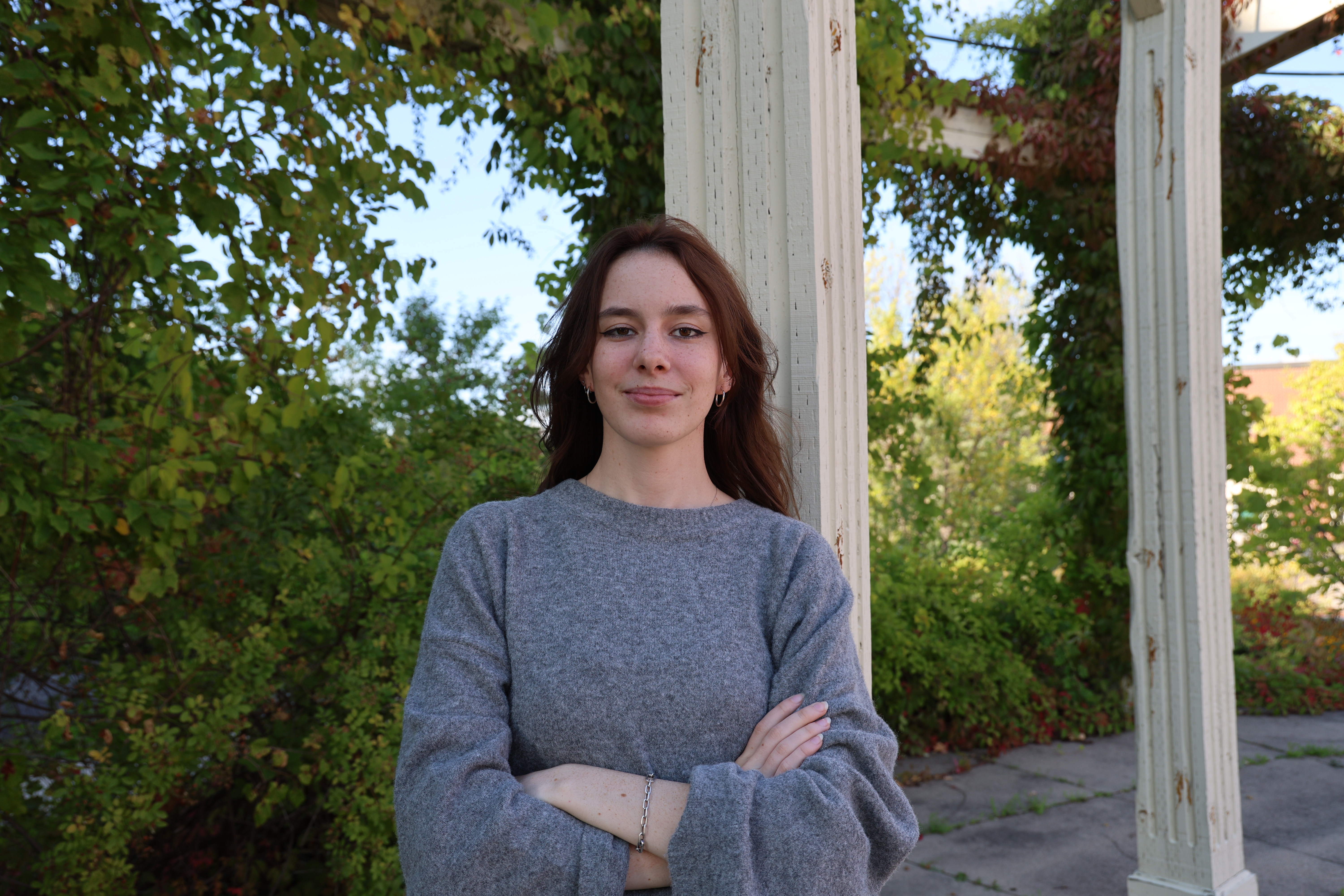
On March 31, for the first time in a long while, I dressed nicely and put on makeup. It was warm, I didn’t even need a coat. There was no electricity, so I had to wash my hair in crystal-cold water over the sink, scooping it with a ladle. A little blush on my cheeks, winged eyeliner. Striped sweater.
I had to tell my mom where I was going and who I was going with. I still cannot believe she let me go. She probably understood something all along.
I walked down the stairs from the ninth floor of our building, slowly, counting every step, in rhythm with my heartbeat. The stairwell smelled faintly of dust and old paint. The walls felt cold under my fingertips. Outside, the air was crisp, carrying a hint of spring that didn’t quite belong here. I stepped onto the street, and he was there. He hugged me. He hugged me as if he might break my ribs. And I laughed, because for the first time in months, at least something good had happened in this war.
For a moment, the world stopped. The sounds of distant explosions, the echoes of gunfire, the cold, the hunger, the fear, all of it faded. There was only that hug. And then, just for a moment, our lips met. A kiss. Quick. Fierce. Fragile. Everything that had been lost, everything that had been waiting, seemed to fit there, between us, for that single heartbeat.
And in this story, there was a kind of happy ending. The next day, April 1, he left. On his way, there were fifty-six checkpoints. He counted them. He returned to Lithuania and continued his studies to become an engineer.
On April 15, I applied for a visa to Canada. At the beginning of May, it was approved. From 5 a.m. on May 26 to 11 p.m. on May 27, my mother, my brother, and I travelled 270 kilometres to Zaporizhzhia. We were leaving the occupation. On our way, there were 112 checkpoints. I counted them. That same night, they bought me a ticket to Halifax.
On June 9, I arrived in Canada.
And him?
The last time we saw each other was March 31, 2022. Every year, on that “anniversary,” we call each other and remember how it was, like old veterans recalling a war we survived. We remember the fear. We remember the cold. We remember the music and the small moments that made life feel possible.
The only thing he ever apologizes for is that he didn’t stay until the lilacs bloomed, so he could give them to me. But beyond that, there is nothing for us to regret. Nothing at all.


Comments